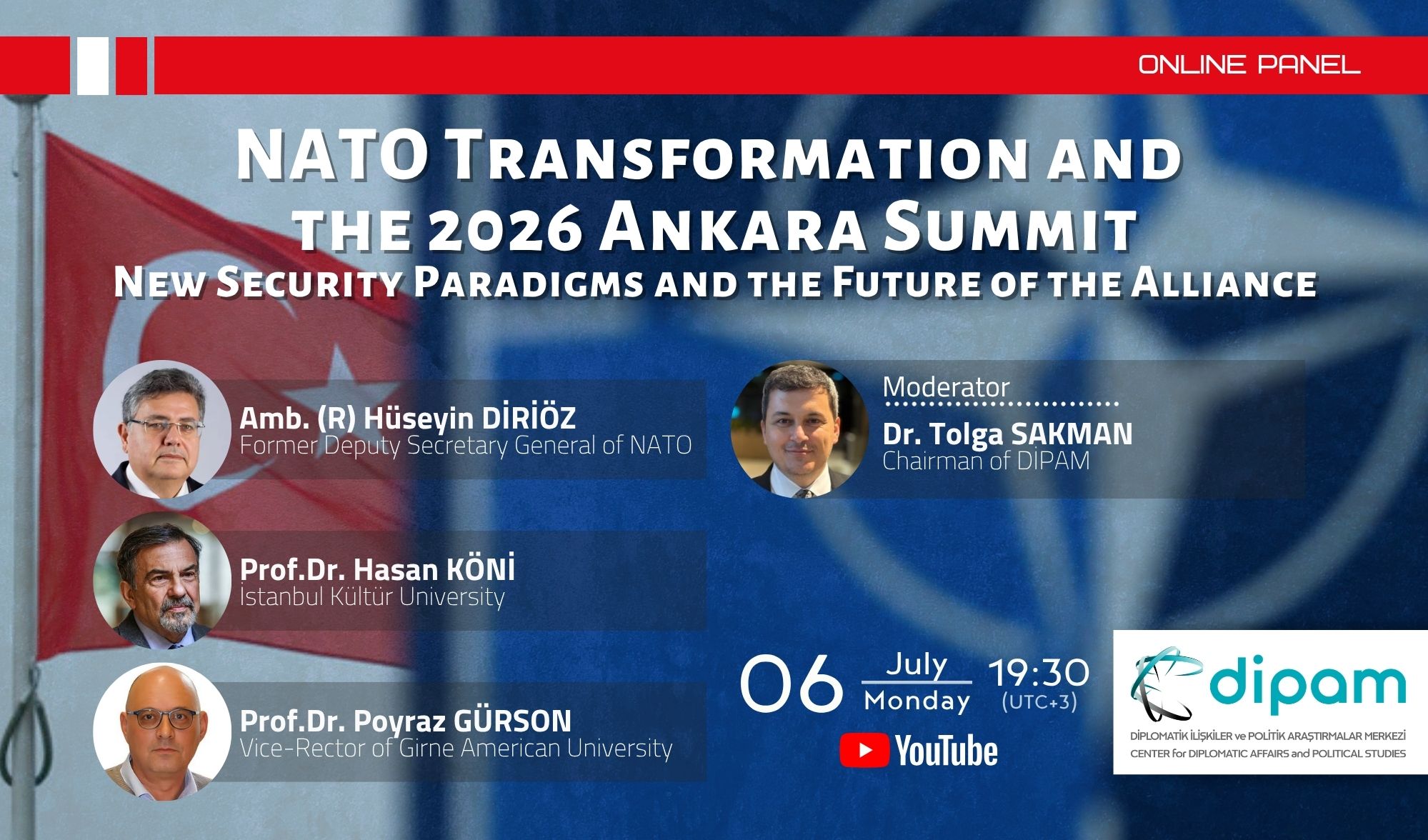
NATO Transformation and the 2026 Ankara Summit: New Security Paradigms and the Future of the Alliance
We are crossing a critical threshold where global geopolitical balances are rapidly shifting, and asymmetric and hybrid threats are challenging conventional military doctrines. The 2026 Ankara Summit, one of the most strategic turning points that will shape the Alliance’s future, has the potential to define NATO’s existential responses and institutional identity for the coming decades. This webinar, to be held amid this dynamic process, aims to examine—from a holistic perspective—NATO’s structural transformation, the deep geopolitical fault lines within the Alliance, and the reconstruction of the global security architecture on the sidelines of the Ankara Summit.
One of the greatest challenges facing the Alliance in today’s security ecosystem is the ability to reconcile differing threat perceptions across geographic regions on common ground. Eastern Europe’s concerns about conventional border security, Southern Europe’s perception of instability driven by irregular migration and terrorism, and Western Europe’s cyber and economic vulnerabilities are seriously testing transatlantic balances. Definitions of next-generation threats, which rank high on NATO’s agenda, will not only reshape the balance of power between Washington and Brussels but also reveal the extent to which the Alliance’s collective defense will remains sustainable.
The most complex aspect of this institutional quest, however, is the debate over strategic autonomy that is taking shape within the European Union. Europe’s insistence on institutionalizing its own defense capabilities based on EU criteria is directly affecting the future of the transatlantic bond. While the practical and military feasibility of this quest is debated, the question of whether the process will serve as a complementary element to NATO or trigger the emergence of a new global alliance structure points to a geopolitical crossroads. On the other hand, the United States’ efforts to create a defense dichotomy in its favor through military and industrial investments on the European continent stand out as another structural dynamic that deepens competition and divisions within continental Europe.
Turkey, as the host of the summit, stands at the very center of this new security paradigm due to its strategic location at the intersection of NATO’s eastern and southern flanks. With its military strength, advances in the domestic defense industry, and multidimensional diplomatic maneuverability, Turkey is moving beyond its traditional role as a flank state within the Alliance to consolidate its position as an autonomous and foundational actor.
Purpose of the Panel
The primary purpose of this panel is to analyze Turkey’s current role in Europe’s emerging new security architecture and to shed light on the Alliance’s intellectual and strategic direction ahead of the 2026 Ankara Summit.
The panel will particularly seek to answer the following questions:
- What are the key issues on NATO’s agenda? Will new threats be identified?
- Can a transatlantic balance be established?
- Can the varying threat perceptions across Eastern, Southern, and Western Europe be reconciled within the Alliance?
- What is the basis for the discussions on strategic autonomy, and is an outcome possible?
- Is the U.S. investing to create a defense divide within Europe?
- Are EU criteria feasible for defense cooperation? If Europe insists on strategic autonomy, will this lead to the formation of a new alliance?
- Does Turkey have a new position within NATO or within Europe’s new security paradigm?
Panel Moderator
Dr. Tolga SAKMAN
Chairman of DİPAM
Speakers
Ambassador (R) Hüseyin DİRİÖZ
Former Deputy Secretary General of NATO
Prof. Dr. Hasan KÖNİ
Istanbul Kültür University
Prof. Dr. Poyraz GÜRSON
Vice-Rector of Girne American University



Comments are closed.