

No Events
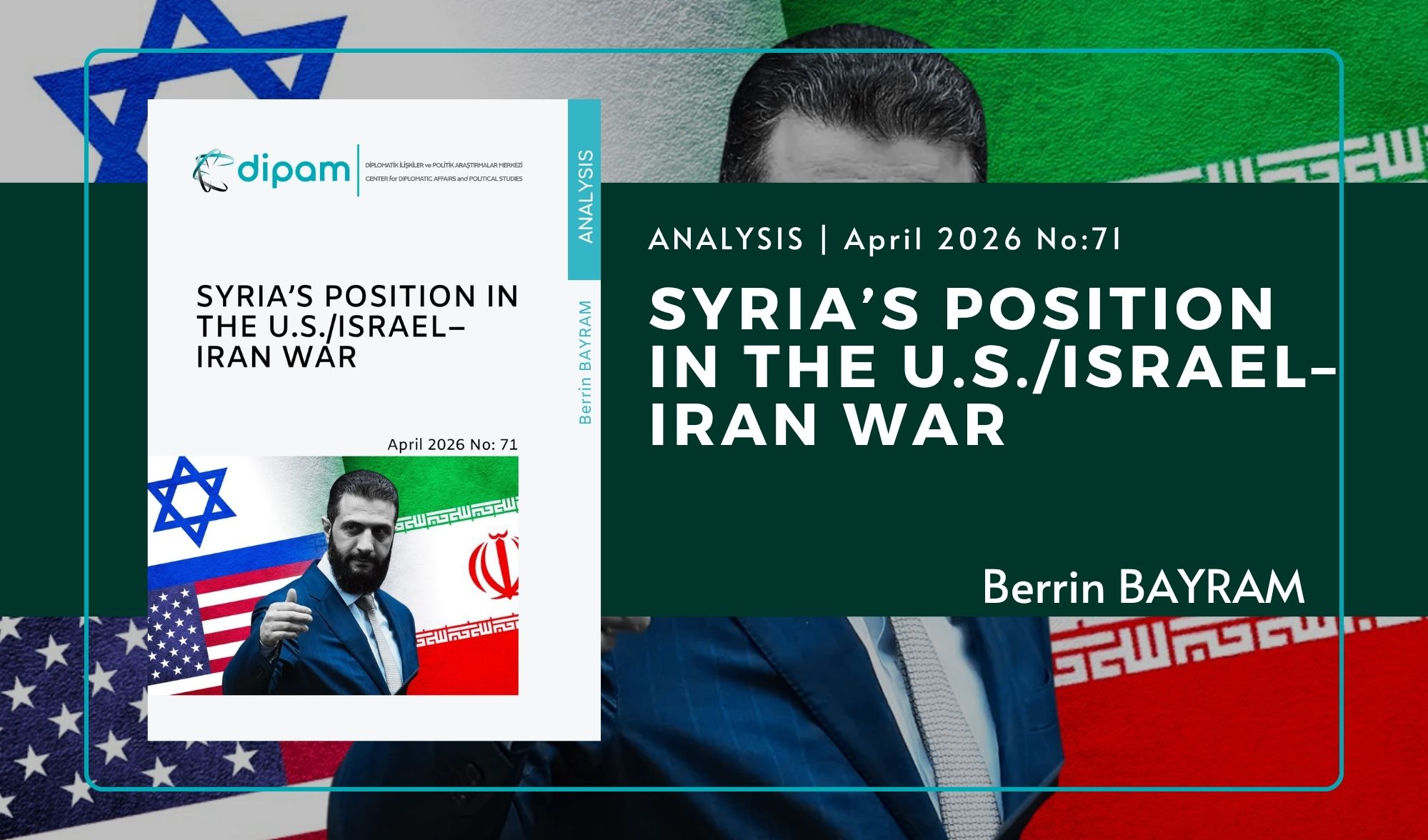
The large-scale military operations launched by the United States and Israel against Iran on February 28, 2026, quickly escalated into a regional crisis, affecting nearly every country in the region. The war marked a pivotal turning point in terms of the Middle East’s security equation and regional geopolitics. Iran, in turn, responded swiftly to the attacks by launching missile and drone strikes against Israel and U.S. bases in the Gulf, causing tensions in the region to escalate rapidly. On the same day, eight countries—including Iran, Israel, Iraq, Jordan, Qatar, Bahrain, Kuwait, and the United Arab Emirates—announced the closure of their airspace, and airline flights were suspended. Syria, meanwhile, announced that it had closed a portion of its airspace along the southern border with Israel for 12 hours. In this context, properly assessing Syria’s response to the February 28 operations necessitates an understanding of the political and strategic transformation the country has undergone following the 2024 leadership transition.
The new political structure that emerged following the change in leadership in Syria in 2024 has reshaped the country’s foreign policy orientations. The administration led by Ahmed al-Shara is striving to recover from the devastation caused by the civil war while simultaneously facing the influence of regional powers in Syria. In this process, the tension between Iran and Israel, in particular, has become one of the key factors directly influencing Syria’s foreign policy.
The new administration has inherited a legacy that prevents it from completely severing the Iran-centered military and political ties established in the past; conversely, Israel’s ongoing attacks on Iran-linked targets within Syrian territory have left the country facing the risk of direct conflict. However, Syria’s limited response to these attacks and its avoidance of becoming a direct party to the conflict indicate that the country has not embarked on a clear shift in alliances.
This analysis argues that, contrary to claims that Syria has chosen a side in the Iran-Israel tension, it has instead pursued a policy of necessary balance. In this context, the historical background and current state of Syria’s relations with Iran will first be examined, followed by an analysis of Israel’s military activities in Syrian territory and Syria’s responses to this situation. Finally, the reasons why the Syrian government has been compelled to adopt a cautious and balanced policy due to both external pressures and internal vulnerabilities will be assessed.
The Historical Background and Current State of Syria–Iran Relations
The foundations of Syrian–Iranian relations date back to the 1979 Iranian Islamic Revolution. During this period, while Syria became one of the first countries to swiftly recognize and support the new regime in Iran—despite its regional isolation—Iran began to pursue anti-imperialist and anti-Israel policies. Thus, the relationship between these two nations evolved into both a strategic partnership and an alliance (Sinkaya, 2011; 39). One of the key developments that elevated Syria–Iran relations to a higher level was Syria’s explicit support for Iran during the Iran–Iraq War, which broke out in 1980. Syria shut down the pipeline enabling Iraq’s oil exports; in return, Iran provided cheap oil and significant material aid, some of which was provided without compensation (Sinkaya, 2011; 39–40). Their joint efforts in the establishment of Hezbollah in Lebanon in 1982 further strengthened this cooperation, and the perception of a common enemy (Israel and Iraq) became the foundation of these relations.
This historical context also explains why Iran swiftly and resolutely supported the Assad regime when the civil war began in Syria in 2011. As Sinkaya emphasizes, from Iran’s perspective, Syria is not merely an ally but also the key link in the chain extending to Hezbollah in Lebanon. For this reason, the survival of the regime in Damascus has become a strategic necessity for Tehran to preserve its regional influence. This relationship, described as a “marriage of convenience,” is noted to be based more on a shared perception of threat and a calculation of interests than on ideological affinity.
…