
Global Strategy Conference 2026
“The New Architecture of Global Security: From Collective Defence to Strategic Competition”
10-11 December 2025 | Istanbul, Türkiye (Hybrid)
The international security system has been undergoing the most comprehensive transformation since the end of the Cold War. The liberal international system, collective security mechanisms, the rules-based international order, and the understanding of economic interdependence, which formed the foundation of the international order for approximately thirty years, have faced a serious challenge with the resurgence of great power competition, the proliferation of regional conflicts, and the acceleration of technological transformation. Today, the concept of security is no longer limited to a narrow framework referring only to the territorial integrity and military capacity of states. Areas such as cyberspace, artificial intelligence, space technologies, critical infrastructure, energy security, supply chains, critical minerals, and economic security have also become integral components of the national and international security architecture.
The Russia-Ukraine War, ongoing instability in the Middle East, deepening strategic competition in the Indo-Pacific, the systemic power struggle between China and the United States, and Europe’s reshaping defence policies demonstrate that the existing security architecture can no longer be explained solely through the understanding of collective defence. Instead, a new security paradigm is emerging in which states operate in a multidimensional and continuous environment of strategic competition. This paradigm brings economic resilience, technological superiority, diplomatic flexibility, and societal resilience capacity to the forefront among the elements of national power, as much as military power.
This transformation directly affects not only the major actors of the international system but also middle powers and regional actors. The pursuit of strategic autonomy, the restructuring of defence industries, the diversification of energy supply security, and the struggle for access to critical technologies are among the new determining dynamics of international relations. NATO’s expanding area of responsibility, Europe’s efforts to increase its defence capacity, emerging new security partnerships in the Indo-Pacific, and the increasing diplomatic manoeuvring space of regional powers demonstrate that the global security architecture is transforming into a multilayered and polycentric structure.
Within this framework, Global Strategy Conference 2026 aims to assess the transformation undergone by the international security system from a holistic perspective with the theme “The New Architecture of Global Security: From Collective Defence to Strategic Competition”, determined this year in light of global developments. The conference’s fundamental starting point is the approach that today’s security environment should no longer be analysed only through responses to crises, but along the axes of long-term strategic competition, technological transformation, and new balances of power. Therefore, the conference aims to create an interdisciplinary forum for discussion that brings together the fields of economics, technology, diplomacy, and geopolitics by taking security studies beyond classical military approaches.
The discussions to be addressed at the conference will not be limited to analysing current security threats; they will also provide policy-oriented assessments concerning the norms, institutions, and strategic priorities around which the international order of the future will be shaped. Thus, the conference will offer a comprehensive strategic analysis platform integrating the military, economic, and technological dimensions of security.
Another important objective of the conference is to strengthen the interaction between academic studies in the field of international security and policymaking processes. Today, it is observed that security policies are shaped not only by state institutions but also by numerous actors such as think tanks, universities, the private sector, and technology companies. Therefore, the conference aims to establish a sustainable dialogue between knowledge production and policy development processes by bringing together academics from different disciplines, decision-makers, diplomats, military experts, and strategic analysis centres on the same platform.
From the perspective of Türkiye, the new security architecture contains both significant opportunities and complex challenges. Located at the intersection of Europe, the Black Sea, the Middle East, the Caucasus, and the Eastern Mediterranean, Türkiye stands out as an important actor in shaping the new international security order with its NATO membership, developing defence industry, central position in energy corridors, and multidimensional diplomatic capacity. Accordingly, the conference aims to assess Türkiye’s role within the changing strategic environment not only in the context of regional developments but also from the perspective of the future of global security governance.
Global Strategy Conference 2026 will take place in Istanbul on 10-11 December 2026, in cooperation with the Center for Diplomatic Affairs and Political Studies (DİPAM), Istanbul Aydın University, and the Trocadéro Forum Institute. The conference aims to comprehensively address the transformation facing international security studies in the new period. At a time when global security is becoming increasingly complex, multi-actor, and multidimensional, the discussions put forward by this conference are expected not only to contribute to the academic literature but also to develop actionable policy recommendations for decision-makers and strengthen international strategic dialogue. In this respect, the conference aims to become an important international platform that contributes to understanding the change in the field of security and supports the production of strategic thought concerning the international order of the future.
Main Theme:
“The New Architecture of Global Security: From Collective Defence to Strategic Competition”
Topics:
- From Deterrence to Resilience: Redefining Security in the Twenty-First Century
- Strategic Competition in the Twenty-First Century: From Military Power to Comprehensive Statecraft
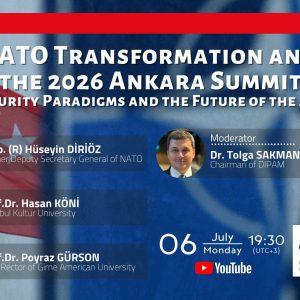
- The Future of Collective Defence: NATO after the Ankara Summit
- Defence Industry in an Era of Competition among Great Powers
- European Security after Ukraine: Defence, Deterrence, and Strategic Autonomy
- The Indo-Pacific and the Emerging Balance of Power
- The New Security Landscape of the Middle East
- Security Cooperation Formulas and Anticipated Risks in Central Asia
- Maritime Security from the Black Sea to the Pacific
- The Arctic, Space, and New Frontiers of Strategic Competition
- Hybrid Warfare and the New Battlespace
- Technology as Power: Artificial Intelligence, Quantum Computing, and Strategic Competition
- Cybersecurity, Space, and Critical Infrastructure Protection
- The Return of Geoeconomics: Trade, Sanctions, and Economic Statecraft
- Strategic Corridors and the New Geography of Global Power
- Energy Security in an Era of Geopolitical Fragmentation
- Security Beyond the Battlefield: Climate, Migration, and Human Mobility
- Middle Powers in a Competitive World Order
- Governance of Global Security: International Institutions in an Era of Strategic Competition
- The Future of Alliances in a Multipolar World
- Strategic Foresight 2035: Scenarios for the Future International Security Order
Presentations on relevant themes are also welcome.
CALL FOR PAPER


Comments are closed.